

Image Details
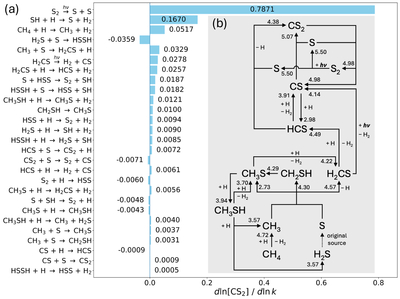
Caption: Figure 2.
(a) Sensitivity coefficients (﹩{S}_{i,{{\rm{CS}}}_{2}}=\frac{d({\rm{ln}}[{{\rm{CS}}}_{2}])}{d({\rm{ln}}{{k}}_{i})}﹩) for the major reactions contributing to CS2 formation at P ∼ 0.1 mbar, shown in descending order from top to bottom. Briefly speaking, reactions with large positive (negative) sensitivity coefficients promote (suppress) CS2 formation (see Section 2.4 for the definition and Section 3.3 for further discussion). Among these, S2 photolysis is identified as the most influential reaction. (b) A schematic diagram illustrating major reaction pathways contributing to the formation of CS2 at the P ∼ 0.1 mbar region in the simulated atmosphere of TOI-6894 b, under the fiducial model conditions (3× Z⊙, Kzz = 108 cm2 s−1, and Tint = 100 K), corresponding to the results shown in Figure 1. Numbers indicate the logarithm of the absolute reaction rate, in units of molecules cm−3 s−1, for each reaction pathway. For example, a value of 5.50 for the S2 destruction pathway corresponds to a rate of 105.50 molecules cm−3 s−1 for the reaction S2 ﹩{\overset{h\nu }{\to }}﹩ S+S reaction. Note that some reactions whose sensitivity coefficients are calculated in panel (a) are omitted from the schematic diagram in panel (b) for visual clarity. As shown, S2 photolysis, which efficiently liberates two sulfur atoms, plays a key role in CS2 formation.
Other Images in This Article
Copyright and Terms & Conditions
© 2026. The Author(s). Published by the American Astronomical Society.

