

Image Details

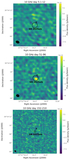
Caption: Figure A3.
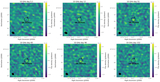
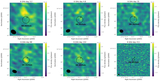
Observations of the SN 2025ulz field carried out at ν ≈ 3 GHz under our JAGWAR program with the VLA in its B configuration. In all panels, the black circle marks a region of radius equal to the nominal FWHM of the VLA synthesized beam at ν ≈ 3 GHz and in B configuration (2﹩\mathop{.}\limits^{{\unicode{x02033}}}﹩1), centered on the position of SN 2025ulz as determined by the brightest pixel in HST images. In Table 1, we report the peak radio flux densities measured within this circular region (if above 3 × RMS) and their positional offset and PA from the HST position of SN 2025ulz. The actual VLA beam is plotted as a black ellipse in each panel. The optical position of the host galaxy (SDSS J155154.16+305409.3) center is marked with a black cross. Map colors span flux density values in between ≈−5 × RMS and +5 × RMS (see Table 1 for the RMS value of each image). While at all epochs the observed flux at the position of SN 2025ulz is dominated by host-galaxy emission, there is a hint for a potential brightening due to the contribution of the AT 2025ulx radio counterpart at day 74.
Other Images in This Article
Copyright and Terms & Conditions
© 2026. The Author(s). Published by the American Astronomical Society.

