

Image Details
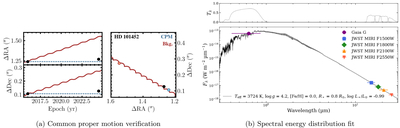
Caption: Figure 3.
Common proper-motion verification and source identification. (a) The relative astrometry of the detected source between the Gaia DR3 information and the MIRI detection is consistent with a comoving companion (dotted blue line) over the expected motion of a stationary background object (solid red line). This test confirms the source is gravitationally associated with the primary star with the comoving model preferred by Δχ2 = 5953. (b) An SED fit of the companion was made using the species package incorporating the Gaia DR3 G magnitude (Gaia Collaboration et al. 2023) and the four MIRI photometry points listed in Table 1. The best-fit SED is consistent with a star with a classification between K7V and M0.5V (M. J. Pecaut & E. E. Mamajek 2013).
Other Images in This Article
Copyright and Terms & Conditions
© 2026. The Author(s). Published by the American Astronomical Society.

