

Image Details
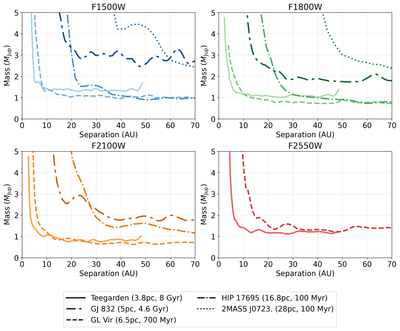
Caption: Figure 4.
S/N = 5 mass limits for neighboring system examples. The HD 101452 contrast curves reported in Figure 2 were translated to mass limits using madys for five nearby systems. These examples appeared on the target lists of one or more JWST direct-imaging programs prior to Cycle 6, and most have a Wide-field Infrared Survey Explorer W4 mag similar to HD 101452 (W4 ∼ 6.8). These plots are displayed to 70 au, but the contrast curves extend to wider separations that are not shown for some targets. F2550W is the least advantageous filter for cold planet hunting using this sort of short-integration MIRI imaging because of the high instrument background levels as compared to the other MIRI filters. The mass constraints of GJ 832, HIP 17695, and 2MASS J07234358+202458 are not shown in the F2550W plot because the limits are greater than 5MJup at all separations. Sensitivity to detect sub-Jupiter-mass gas-giant planet candidates can be reached using 34 s of F1800W/F2100W for three of the five example cases where a combination of very near proximity (<4 pc) or youth (<100 Myr) is present.
Other Images in This Article
Copyright and Terms & Conditions
© 2026. The Author(s). Published by the American Astronomical Society.

