

Image Details
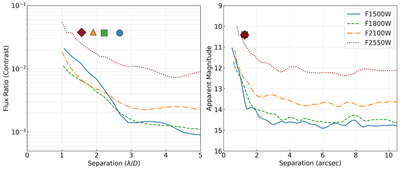
Caption: Figure 2.
Contrast curves and detected companion. (Left) The 5 S/N contrast is plotted as the flux ratio as a function of the angular separation in units of λ/D, where λ is the central wavelength of the filter and D = 6.5 m is JWST’s primary mirror diameter. The photometry values measured for the companion are represented for each filter as a blue circle (F1500W), green square (F1800W), golden triangle (F2100W), and red diamond (F2550W). The error bars for the photometry are plotted but lie inside the bounds of the symbol in each case. (Right) The same 5 S/N contrast curves are shown in apparent Vega magnitude and plotted as a function of separation in arcseconds. The stellar companion was detected in all four MIRI filters, including at the longest wavelengths where the projected separation is less than 2λ/D. These observations demonstrate that noncoronagraphic MIRI imaging can recover companions at separations traditionally associated with coronagraphy provided that a well-matched reference star in flux counts is available for PSF subtraction.
(The data used to create this figure are available in the online article.)
(The data used to create this figure are available.)
Other Images in This Article
Copyright and Terms & Conditions
© 2026. The Author(s). Published by the American Astronomical Society.

