

Image Details
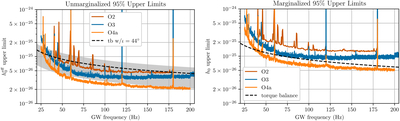
Caption: Figure 5.
Upper limits from cross-correlation searches for Sco X-1 in Advanced LIGO data. Left: the upper limit shown is on ﹩{h}_{0}^{\,{\rm{eff}}\,}﹩, defined in Equation (4). This is equivalent to the upper limit on h0 assuming circular polarization. The “O4a” curve shows the results of the present resampling CrossCorr search. “O3” is the CrossCorr search (B. P. Abbott et al. 2022a), and “O2” is the resampling CrossCorr search of Y. Zhang et al. (2021). For comparisons among O3 searches with different methods, see B. P. Abbott et al. (2022a). The gray shaded region corresponds to the range of amplitudes corresponding to the nominal expected level assuming torque-balance [Equation (7)], which depends on the unknown inclination angle. The dashed line (labeled as “tb w/ι = 44∘”) corresponds to the assumption that the NS spin is aligned to the most likely orbital angular momentum, and ι ≈ i ≈ 44∘. (See Table 1.) Right: marginalized upper limits on h0, assuming an isotropic prior on the neutron star spin inclination ι, with the dashed line indicating the level predicted by torque balance. (Note that this marginalized upper limit is dominated by linear polarization, and so is a factor of almost ﹩\sqrt{8}﹩ higher than the unmarginalized upper limit.) The present search has, for the first time, set an upper limit below the torque-balance prediction at any inclination angle for 50 Hz < f0 < 200 Hz.
Other Images in This Article
Copyright and Terms & Conditions
© 2026. The Author(s). Published by the American Astronomical Society.

