

Image Details
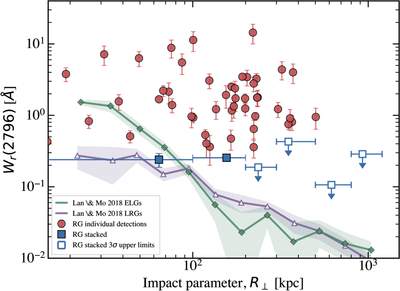
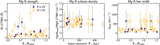
Caption: Figure 5.
Mg IIλ2796 rest-frame equivalent width as a function of projected impact parameter, R⊥. Red circles show individual Mg II detections associated with the radio-galaxy sight lines in this work. Nondetections are not shown as individual points in this panel; however, they are included in the stacked measurements and they contribute to the low mean equivalent widths in the radial bins. Filled blue squares show the measurements from stacked profiles, while open blue squares indicate 3σ upper limits from stacks without individual detections. For comparison, the green and purple curves show the average Mg II absorption profiles around emission-line galaxies and luminous red galaxies from T.-W. Lan & H. Mo (2018), respectively, with shaded regions indicating the reported uncertainties. Individual radio-galaxy absorbers are detected over a broad range of projected radii, including beyond ∼100 kpc, and several lie above the average LRG profile. However, the stacked signal is weak and several radial bins yield only upper limits, indicating that the cool Mg II-bearing gas around radio galaxies is extended and clumpy, with a low covering fraction rather than a smooth, high-covering-fraction halo component.
Other Images in This Article
Copyright and Terms & Conditions
© 2026. The Author(s). Published by the American Astronomical Society.

