

Image Details
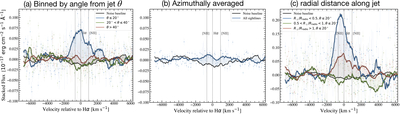
Caption: Figure 2.
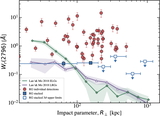
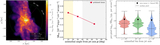
Panel (a): angle-binned stacked residual spectra. Sight lines within ±20∘ of the radio axis show an Hα excess at the rest-frame wavelength centered at the foreground host galaxies’ systemic redshifts, but no comparable excess is seen at intermediate- or large-angle sight lines. The result indicates that the cool ionized CGM signal is strongly anisotropic and aligned with the projected radio structure. Panel (b): azimuthally averaged stacked residual DESI spectrum around foreground radio galaxies. The spectrum is shifted to the foreground-galaxy rest frame and centered on Hα. The all-angle stack shows no significant Hα excess, with an integrated significance of <2σ relative to randomized blank stacks. This null result rules out a simple spherically enhanced Hα halo but does not test for directional jet–CGM coupling. Panel (C): integrated Hα signal as a function of normalized projected distance from the host galaxy for sight lines within ±20∘ of the radio axis. The line excess is strongest near the galaxy and again near the projected radio-lobe/cocoon region, suggesting two preferred zones where radio jets couple to cool ionized halo gas.
Other Images in This Article
Copyright and Terms & Conditions
© 2026. The Author(s). Published by the American Astronomical Society.

