

Image Details
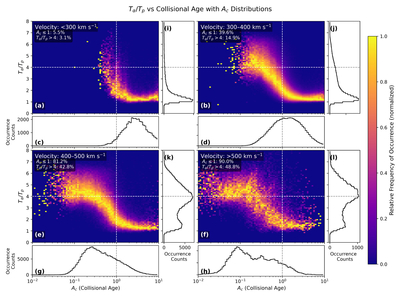
Caption: Figure 3.
This figure shows the variation of the temperature ratio Tα/Tp as a function of the Coulomb collisional age (Ac) for different solar wind speed bins: (a) <300 km s−1, (b) 300–400 km s−1, (e) 400–500 km s−1, and (f) >500 km s−1. The color scale represents the normalized relative frequency of occurrence. The dashed vertical line marks Ac = 1, distinguishing weakly (Ac < 1) and strongly (Ac > 1) collisional regimes, while the horizontal dashed line at Tα/Tp = 4 indicates the threshold for significant mass-proportional heating of alpha particles. The inset boxes in each panel list the percentage of data points within the weakly collisional regime (Ac < 1) and those exhibiting enhanced heating (Tα/Tp > 4. Panels (c), (d), (g), and (h) show the corresponding distributions of measurement occurrences as a function of collisional age for <300, 300–400, 400–500, and >500 km s−1 speed bins, respectively, providing the relative population of plasma intervals contributing to the two-dimensional distributions above. Panels (i), (j), (k), and (l) show the corresponding marginal distributions of Tα/Tp for the same speed bins, illustrating the systematic shift toward higher temperature ratios with increasing solar wind speed. The results demonstrate that mass-proportional heating is predominantly observed in the weakly collisional, high-speed solar wind, where collisional relaxation is minimal.
Other Images in This Article
Copyright and Terms & Conditions
© 2026. The Author(s). Published by the American Astronomical Society.

