

Image Details
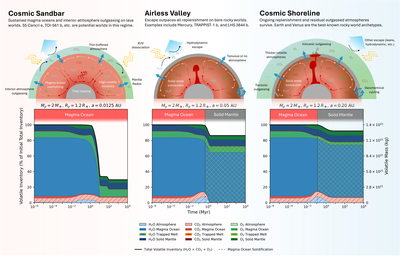
Caption: Figure 1.
Schematic of the three atmospheric retention and loss regimes for close-in rocky planets. Illustrated diagrams appear above stacked area charts tracking the volatile reservoir evolution of representative fiducial planets (2 M⊕, 1.2 R⊕, G star host, ﹩{F}_{{{\rm{H}}}_{2}{\rm{O}}}=1{0}^{-3}﹩, ﹩{F}_{{{\rm{CO}}}_{2}}=1{0}^{-4}﹩, e = 0). Colored regions show retained volatile inventories in the atmosphere, magma ocean, trapped melt, and solid mantle as percentages of the initial total volatile inventory, with equivalent kg on the right axis. The black curve shows the total retained H2O, CO2, and O2-equivalent free oxygen inventory. Atmospheric O is tracked as molecular O2, while magma ocean and mantle O are bound as ferric oxide, including the initial primordial concentration. The yellow-hatched band marks the uncertainty of residual melt sealed at the rheological transition. We assume no post-solidification outgassing, so this uncertainty band represents the possible lower and upper range of total volatile retention in the interior reservoir, since compaction, geochemical cycling, tectonics, volcanism, late-stage crystallization, and other residual outgassing could further drain the interior and return volatiles to the atmosphere. (L. Elkins-Tanton 2008; M. M. Hirschmann 2012; K. Hamano et al. 2013; T. Lebrun et al. 2013; L. Schaefer et al. 2016; S. Hier-Majumder & M. M. Hirschmann 2017; T. Lichtenberg et al. 2026). Left: In the fiducial outgassing-regulated sandbar example (a = 0.0125 au), a sustained magma ocean keeps most volatiles dissolved in the melt and exposes only a thin atmosphere to escape. Middle: In the fiducial airless valley example (a = 0.05 au), magma ocean solidification partitions volatiles between the atmosphere and sequestered interior, after which atmospheric escape outpaces replenishment. Right: For a representative planet beyond the escape-regulated shoreline (a = 0.20 au), outgassed atmospheres survive over Gyr timescales.
Other Images in This Article
Copyright and Terms & Conditions
© 2026. The Author(s). Published by the American Astronomical Society.

