

Image Details
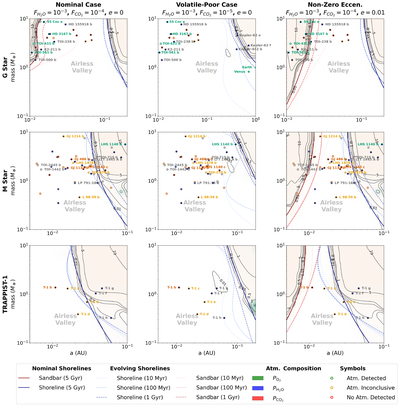
Caption: Figure 2.
A 50 by 50 grid of planetary mass (M⊕) and orbital distance (AU) showing contours of total atmospheric pressure after 5 Gyr, including pressures >1 bar, relevant for future JWST, HWO, and Roman detectability. Columns show the nominal volatile budget on circular orbits (left), reduced volatile budgets (middle), and the nominal budget with tidal heating at constant e = 0.01 (right). The e = 0.01 column is a sustained-forcing upper limit for compact, high-multiplicity systems in which secular excitation maintains nonzero eccentricity, as isolated short-period planets circularize within ≲0.1–3 Myr. Red and blue curves mark the outgassing-regulated cosmic sandbar and the escape-regulated cosmic shoreline, solid at 5 Gyr and dashed at 10 Myr, 100 Myr, and 1 Gyr. Contours are shaded by predicted atmospheric composition. Observed rocky exoplanets are overlaid by stellar type from the DDT survey, E. K. Pass et al. (2025), the NASA Exoplanet Archive, and the IAC ExoAtmospheres database. Best-fit relations are provided in Table A1. In some TRAPPIST-1 cases, the fitted shoreline appears to move outward with time at low masses, reflecting the limits of low-order polynomial fits to a strongly curved boundary, so below ∼0.3 M⊕ the fits should be read as approximate guides.
Other Images in This Article
Copyright and Terms & Conditions
© 2026. The Author(s). Published by the American Astronomical Society.

