

Image Details
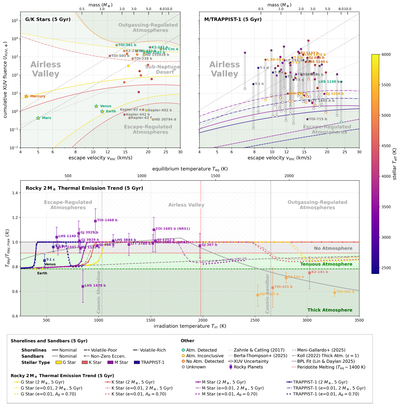
Caption: Figure 3.
Evolving shorelines and sandbars at 5 Gyr, including the cases of Figure 2 and a volatile-rich case (﹩{F}_{{{\rm{H}}}_{2}{\rm{O}}}=1{0}^{-2}﹩, ﹩{F}_{{{\rm{CO}}}_{2}}=1{0}^{-3}﹩, e = 0) for M stars and TRAPPIST-1, motivated by possible water-rich formation. Top left and right: cosmic sandbars and shorelines from Figure 2 in escape velocity–XUV fluence space, with best-fit relations in Table A2. We do not show the sandbar for M dwarfs and TRAPPIST-1 because long-lived tidal heating is difficult to sustain against circularization in such compact systems (J. H. Hamer & K. C. Schlaufman 2020; E. J. Lee & J. E. Owen 2025), though induction heating could play a role (K. G. Kislyakova 2018). Bottom: Heat redistribution for a fiducial 2 M⊕ super-Earth with nominal volatile inventories orbiting different stellar hosts, for zero and nonzero eccentricity, following D. D. B. Koll (2022), with observed planets from Z. Lin & T. Daylan (2026), including HD 3167 b from B. P. Coy et al. (2026) and LHS 1140 b from C. Cherubim et al. (2026). The airless valley boundaries encompass the possible thick volatile and/or silicate vapor atmospheres centered around the peridotite melting point (Teq ≈ 1400 ± 700 K). Reflective silicate clouds (AB = 0.70) may further lower the thermal ratio. Machine-readable data reproducing the bottom-panel thermal ratio curves are provided as Data behind the Figure in the online article in a .tar.gz package.
(The data used to create this figure are available in the online article.)
(The data used to create this figure are available.)
Other Images in This Article
Copyright and Terms & Conditions
© 2026. The Author(s). Published by the American Astronomical Society.

