Image Details

Choose export citation format:

The Orbital Eccentricity–Radius Distribution for Warm, Single Planets in TESS

  • Authors: Tyler R. Fairnington, Jiayin Dong, Chelsea X. Huang, Emma Nabbie, George Zhou, Duncan Wright, Karen A. Collins, David Ciardi, Jon M. Jenkins, David W. Latham, George Ricker, Samuel N. Quinn, Sara Seager, Avi Shporer, Roland Vanderspek, Joshua N. Winn, Khalid Barkaoui, Allyson Bieryla, Lars Buchhave, Dmitry Cheryasov, Jessie Christiansen, Courtney Dressing, Akihiko Fukui, Alexey Garmash, Steven Giacalone, Eric G. Hintz, Steve B. Howell, Keisuke Isogai, Jerome de Leon, Jorge Lillo-Box, Felipe Murgas, Norio Narita, Louise D. Nielsen, Enric Palle, Markus Rabus, Benjamin V. Rackham, Richard P. Schwarz, Gregor Srdoc, Denise C. Stephens, Gavin Wang, Noriharu Watanabe, Francis P. Wilkin, Joe Williams

Tyler R. Fairnington et al 2026 The Astrophysical Journal Letters 1008 .

  • Provider: AAS Journals

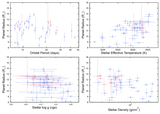
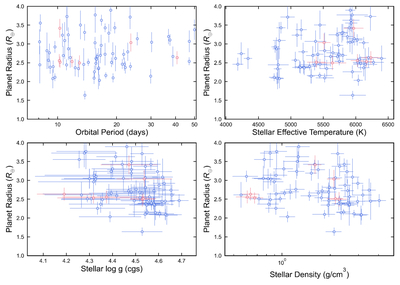
Caption: Figure A1.

Host–planet properties for the Rp < 4 R subsample. Planet radius is shown as a function of orbital period (upper left), stellar effective temperature (upper right), stellar surface gravity ﹩\mathrm{log}g﹩ (lower left), and stellar density ρ (lower right). Blue points denote the full small-planet sample, while red points highlight systems whose individual photoeccentric posteriors have eccentricity modes emode > 0.5. Error bars show the 68% credible intervals.

Other Images in This Article
Show More

Copyright and Terms & Conditions

Additional terms of reuse