Image Details

Choose export citation format:

The Orbital Eccentricity–Radius Distribution for Warm, Single Planets in TESS

  • Authors: Tyler R. Fairnington, Jiayin Dong, Chelsea X. Huang, Emma Nabbie, George Zhou, Duncan Wright, Karen A. Collins, David Ciardi, Jon M. Jenkins, David W. Latham, George Ricker, Samuel N. Quinn, Sara Seager, Avi Shporer, Roland Vanderspek, Joshua N. Winn, Khalid Barkaoui, Allyson Bieryla, Lars Buchhave, Dmitry Cheryasov, Jessie Christiansen, Courtney Dressing, Akihiko Fukui, Alexey Garmash, Steven Giacalone, Eric G. Hintz, Steve B. Howell, Keisuke Isogai, Jerome de Leon, Jorge Lillo-Box, Felipe Murgas, Norio Narita, Louise D. Nielsen, Enric Palle, Markus Rabus, Benjamin V. Rackham, Richard P. Schwarz, Gregor Srdoc, Denise C. Stephens, Gavin Wang, Noriharu Watanabe, Francis P. Wilkin, Joe Williams

Tyler R. Fairnington et al 2026 The Astrophysical Journal Letters 1008 .

  • Provider: AAS Journals

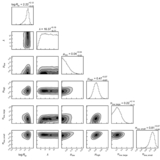
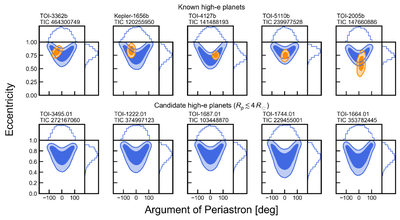
Caption: Figure 3.

Joint posterior constraints of eω from our photoeccentric-effect analysis. Each mini-corner panel shows the marginalized posteriors of ω (top) and e (right), along with their joint distribution (lower left). The top row displays previously known high-eccentricity systems, while the bottom row shows newly identified candidate high-e planets with Rp ≲ 4, R. For the known systems, the published radial-velocity solutions (J. Dong et al. 2021b; J. I. Espinoza-Retamal et al. 2023; A. F. Gupta et al. 2023; A. Bieryla et al. 2025; N. Heidari et al. 2025) are overlaid as orange Gaussian approximations in e and ω for visual comparison.

Other Images in This Article
Show More

Copyright and Terms & Conditions

Additional terms of reuse