

Image Details
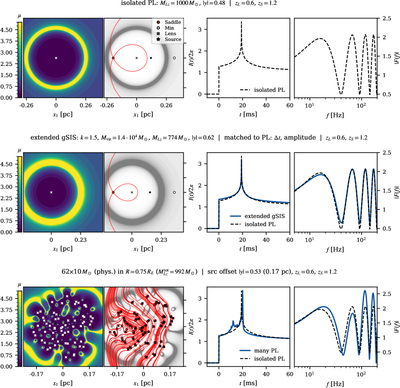
Caption: Figure E1.
Alternatives to a single heavy microlens (isolated configurations at zL = 0.6, zS = 1.2), in order of increasing complexity. Each row shows the magnification map and time-delay contours in the lens plane (left panels, physical units; microlens positions, image positions, and source as labeled), the time-domain lensing response I(t), and the amplification factor ∣F(f)∣ (right panels); the isolated point lens (black dashed) is repeated in all rows for comparison. Top panels: fiducial isolated point lens with MLz = 103 M⊙ and image delay Δt ≈ 20 ms, comparable to the GW231123 wave-optics feature. Middle panels: extended gSIS lens (k = 3/2) matched to the point lens’ delay and peak amplification. The effective mass MLz ≃ 770 M⊙, but total (virial) mass Mvir ≃ 1.4 × 10⁴ M⊙. Bottom panels: 62 point lenses of 10 M⊙ within 0.75 RE (same total mass and source offset). The stellar field reproduces the heavy lens’ response, resolving the saddle spike into micro-caustic features.
Other Images in This Article
Show More
Copyright and Terms & Conditions
© 2026. The Author(s). Published by the American Astronomical Society.

