

Image Details
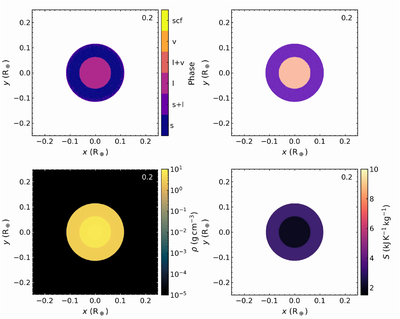
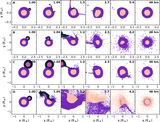
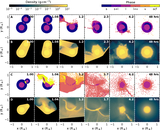
Caption: Figure A3.
Progression of example simulated accretion collision. Instantaneous phase (top left: solid, mixed solid and liquid, liquid, mixed liquid and vapor, vapor, or supercritical fluid), materials (top right: core—light/dark pink, mantle—purple/dark blue—for target/projectile), density (bottom left), and entropy (bottom right) in the midplane as an accretion collision with a 10−3 M⊕ target, a mass ratio of 10−2 at 3vesc, and an impact angle of 30∘ (b = 0.5) progresses over the 48 hr of the simulation. The number in the upper right of each panel is the simulation time in hours. Phase and material panels show SPH particle positions, where white indicates no particles exist at that location. Density and entropy panels show the fluid representation using (3D) interpolation, and so can be defined between particle positions; black and white areas are either at or below the minimum shown on the color scale, or indicate regions in which there are no particles that allow the interpolation. The duration of the animation is 35 s.
(An animation of this figure is available in the online article.)
(An animation of this figure is available.)
The video/animation of this figure is available in the online journal.
Other Images in This Article
Show More
Copyright and Terms & Conditions
© 2026. The Author(s). Published by the American Astronomical Society.

