

Image Details
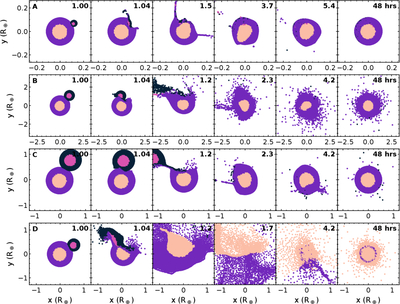
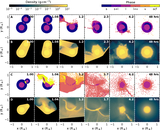
Caption: Figure A1.
Progression of four example simulated collisions showing materials. Materials and provenance of mass (core—light/dark pink, mantle—purple/dark blue—for target/projectile) in the midplane for the same four example collisions shown in Figures 1 and A2. The number in the upper right of each panel is the simulation time in hours. Plots show the SPH particle positions. A: an accretion collision with a 10−3 M⊕ target, a mass ratio of 10−2 at 3vesc, and an impact angle of 30∘ (b = 0.5). B: a mildly erosive collision with a 1 M⊕ target, a mass ratio of 0.1 at 5vesc, and an impact angle of 45∘ (b = 0.707). C: a hit-and-run collision with a 0.1 M⊕ target, a mass ratio of 0.5 at 4vesc, and an impact angle of 60∘ (b = 0.87). D: an erosive collision with a 0.1 M⊕ target, a mass ratio of 0.1 at 12vesc, and an impact angle of 30∘ (b = 0.5). Note a different scale is used for each collision.
Other Images in This Article
Show More
Copyright and Terms & Conditions
© 2026. The Author(s). Published by the American Astronomical Society.

