

Image Details
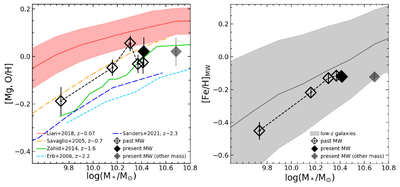
Caption: Figure 3.
The Milky Way in the mass–metallicity plane. Left: light-weighted average magnesium abundance of the Milky Way’s mono-age stellar populations in comparison with gas-phase oxygen abundance of galaxies at different redshifts. Evolution track of the Milky Way in mass–metallicity plane is presented in black diamonds. The measurements of the youngest age bin of 0–2 Gyr are assumed to be representative of the Milky Way at present day and indicated by filled symbols. The present-day measurement with an earlier stellar mass estimate of the Milky Way that did not account for the flattened inner disk profile is shown in gray filled diamonds. All extragalactic mass measurements have been converted to be based on Kroupa initial mass function (P. Kroupa 2001) and oxygen abundances recalibrated to the empirical N2 method (M. Pettini & B. E. J. Pagel 2004). The red shaded region denotes 1σ scatter of the distribution in low-redshift galaxies. Right: mass-weighted, temporally integrated average iron abundance of the Milky Way at each lookback time in comparison with mass-weighted stellar metallicity of low-redshift galaxies. The gray solid line and shaded region indicate the median mass–metallicity relation of low-redshift star-forming galaxies presented in the left-hand panel and its 1σ scatter, respectively.
Other Images in This Article
Copyright and Terms & Conditions
© 2026. The Author(s). Published by the American Astronomical Society.

