

Image Details
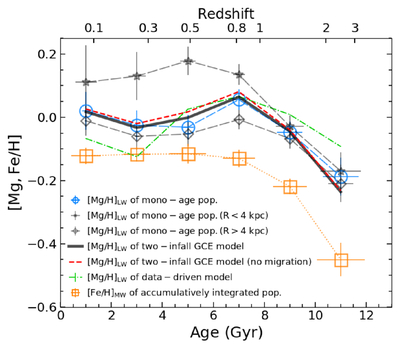
Caption: Figure 2.
Average metallicity of the Milky Way galaxy as a function of age. The light-weighted average magnesium abundance ([Mg/H]LW) of mono-age populations, which is integrated over the entire Galaxy and comparable to the gas-phase metallicity measurements of external galaxies at different redshifts, are shown in blue circles. [Mg/H]LW of the Galaxy within and beyond 4 kpc are shown in gray stars and diamonds, respectively. Black solid and green dashed–dotted lines depict the prediction of chemical evolution model involving a recent gas-accretion event (J. Lian et al. 2020b) and data-driven model best-fitting the resolved age–[Fe/H] relations across the Galaxy (H. Zhang et al. 2026), respectively. The red dashed curve shows the late-accretion model with no radial migration. The mass-weighted integrated iron abundance ([Fe/H]MW) at each lookback time, which is comparable to the stellar metallicity of galaxies, are shown in orange squares. Error bars denote 1σ uncertainty of the measurements.
Other Images in This Article
Copyright and Terms & Conditions
© 2026. The Author(s). Published by the American Astronomical Society.

