

Image Details
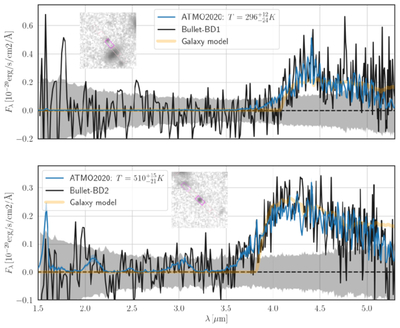
Caption: Figure 2.
NIRSpec PRISM spectra of the F356W dropout (Bullet-BD1, 7107472, top) and F277W dropout (Bullet-BD2, 7107197, bottom) with slit placement insets. Also shown are flux uncertainties in gray. We show model fits using the ATMO2020 model (A. M. Meisner et al. 2023) built into NIFTY (K. N. Hainline et al. 2026b) in blue. In yellow, we show best-fit galaxy model fits (at z = 32.2 ± 0.5 and 30.0 ± 0.1) using Bagpipes. Brown dwarf templates fit the data marginally better (χ2/dof = 1.26 versus 1.27 for Bullet-BD1 and χ2/dof = 0.97 versus 1.23 for Bullet-BD2).
(The data used to create this figure are available in the online article.)
(The data used to create this figure are available.)
Other Images in This Article
Copyright and Terms & Conditions
© 2026. The Author(s). Published by the American Astronomical Society.

