

Image Details
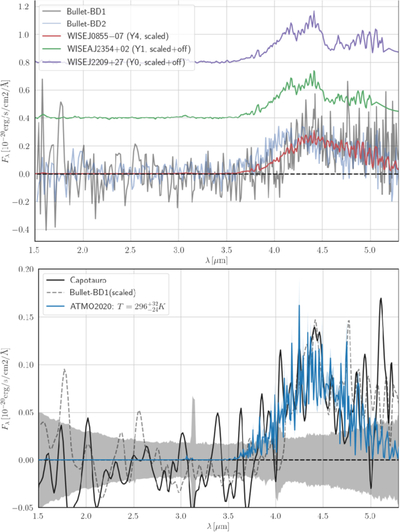
Caption: Figure 4.
(Top) Comparison of the Bullet-BD1 (black), Bullet-BD2 (blue), and WISE J085510.83-071442.5 spectra (scaled to match the flux between 1.5 and 5.3 μm) from K. L. Luhman et al. (2023) (red), indicating BD1 and WISE0855 have similar characteristics. We additionally plot low-temperature (Y dwarfs) WISEA J2354+02 with Teff = 359 K and WISE J2209+27 Teff = 367 K from S. A. Beiler et al. (2024) (scaled and offset for clarity). (Bottom) Comparison of the Capotauro spectrum (black line, gray-shaded noise) with the Bullet-BD1 spectrum (scaled by a factor of 2.67 to match the fluxes in the wavelength range of 4.2 to 4.6 μm). Also shown is the best-fit brown dwarf model spectrum, derived with NIFTY and ATMO2020, in blue. Both observed spectra were smoothed with a Gaussian (σ = 2) for a better visual comparison.
Other Images in This Article
Copyright and Terms & Conditions
© 2026. The Author(s). Published by the American Astronomical Society.

