

Image Details
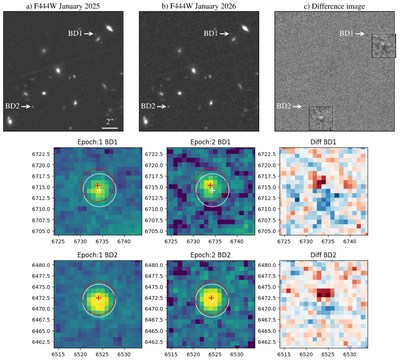
Caption: Figure 3.
Detected proper motion of the two objects. Top: shown is a 16″ × 16″ cutout of the field with Bullet-BD1 and Bullet-BD2 marked. Left column (a) shows the original F444W image taken by the JWST Silver Bullet collaboration (epoch 1), middle column (b) is the image taken ∼1 yr later by the VENUS collaboration (epoch 2), and right panel (c) shows the difference image between epochs 2 and 1 with zoomed insets for the two objects of interest. Middle and bottom: zoom in to the same images (for difference, red is positive, blue is negative). Both objects can be seen moving (white circular aperture is for epoch 1, red for epoch 2; crosses denote their centroids) in a similar direction (20° measured north through east) with proper motion of (49 ± 8) mas yr−1 for Bullet-BD1 and (24 ± 3) mas yr−1 for Bullet-BD2.
Other Images in This Article
Copyright and Terms & Conditions
© 2026. The Author(s). Published by the American Astronomical Society.

