

Image Details
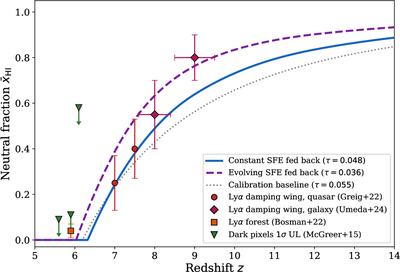
Caption: Figure 5.
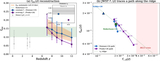
Reionization timeline for both fed-back reconstructions against EoR data. Blue solid: constant-SFE (τe = 0.048); purple dashed: evolving-SFE (τe = 0.036); gray dotted: calibration baseline. Red circles: quasar Lyα damping-wing measurements (B. Greig et al. 2022); magenta diamonds: galaxy Lyα damping-wing measurements (H. Umeda et al. 2024), whose horizontal bars indicate the redshift uncertainty; orange square: Lyα forest (S. E. I. Bosman et al. 2022); green triangles: dark-pixel 1σ upper limits (I. McGreer et al. 2015), satisfied by both histories. We plot the two damping-wing types separately because galaxy measurements carry larger systemic-redshift uncertainties and are more sensitive to cosmic variance than quasar sightlines (S. Bruton et al. 2023; C. A. Mason et al. 2026). The reconstructed τe values (0.048 and 0.036) compare with Planck PR3 (N. Aghanim et al. 2020) (0.054 ± 0.007) and PR4/SRoll2 (L. Pagano et al. 2020) (0.059 ± 0.006): the evolving-SFE history tracks the z = 8–9 damping-wing points but is globally delayed, producing a τe deficit of 2.6σ (PR3) to 3.8σ (PR4), so local agreement with ﹩{\bar{x}}_{{\rm{HI}}}(z)﹩ does not guarantee consistency with the integral constraint.
Other Images in This Article
Copyright and Terms & Conditions
© 2026. The Author(s). Published by the American Astronomical Society.

