

Image Details
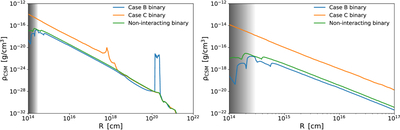
Caption: Figure 4.
CSM density profiles for a binary system with an 18 M⊙ donor and a 16.2 M⊙ companion, constructed from the mass-loss history shown in Figure 3. The left panel shows the full radial extent of the CSM, while the right panel zooms in on the inner region relevant to interacting SNe. The gray shaded region at r ≲ 3 × 1014 cm indicates the approximate binary orbital separation; regions within this radius are excluded from the CSM profile. Compared to the noninteracting case, binary interactions produce denser and more structured CSM, including shell-like features during RLOF.
Other Images in This Article
Copyright and Terms & Conditions
© 2026. The Author(s). Published by the American Astronomical Society.

Copyright ©
2026 Astronomy Image Explorer. All Rights Reserved.
