

Image Details
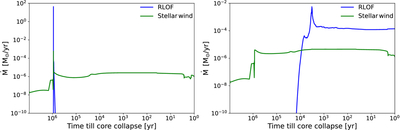
Caption: Figure 3.
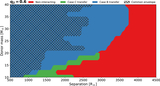
Mass-loss history of an 18 M⊙ donor star undergoing binary interaction. The left panel shows the Case B model, and the right panel shows the Case C model. The companion mass is 16.2 M⊙, with initial orbital separations of 2400 R⊙ (Case B) and 3000 R⊙ (Case C). The x-axis indicates time before core collapse, and the y-axis shows the mass-loss rate. Although Case B can reach high mass-loss rates, this occurs ∼1 Myr before core collapse and therefore does not contribute to the formation of dense CSM immediately prior to explosion. In contrast, Case C mass transfer occurs ∼104 yr before core collapse and can persist until explosion.
Other Images in This Article
Copyright and Terms & Conditions
© 2026. The Author(s). Published by the American Astronomical Society.

