

Image Details
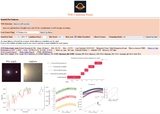
Caption: Figure 10.
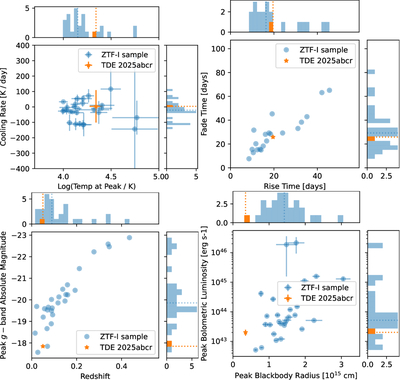
A waterfall plot highlights the main features that contribute to the machine learning classification of TDE 2025abcr as a likely TDE by tdescore, as described in R. Stein et al. (2024). As of 2025 November 29, the classification is driven primarily by the high lower bound on blackbody temperature (T > 104.02 K), the poor fit to an SN Ia with sncosmo (K. Barbary et al. 2016) (χ2 per d.o.f. = 4.5), and the best-fit temperature increasing with time rather than cooling (+87 K day−1). All properties are characteristic of TDEs (which are hot, slowly evolving, and do not rapidly cool), but are not common for SNe (which have lower temperatures, more rapid evolution, and generally cool more quickly). The exact parameters differ slightly from Section 4.1.1, because they are based on a fit to only ZTF data and include only photometry available up to 2025 November 29.
Other Images in This Article
Show More
Copyright and Terms & Conditions
© 2026. The Author(s). Published by the American Astronomical Society.

