

Image Details
Caption: Figure 6.
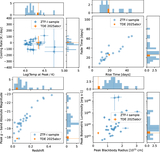
Comparison of the optical lightcurve properties of TDE 2025abcr (in orange) and the sample of TDEs reported in E. Hammerstein et al. (2023) (in blue). The median of each distribution is illustrated with a dashed line. The best-fit values for TDE 2025abcr differ slightly from those in Figure 3, because no UV data were included in these fits. Top left: best-fit peak temperature vs. cooling rate for TDEs, using the thermal model outlined in Section 4.1.1 and fitting only ZTF photometric data. Top right: best-fit rise time and fade time for the same sample and fitting procedure, with the time defined as days between peak magnitude and 0.5 mag below peak. Lower left: redshift vs. peak absolute g-band magnitude. Lower right: bolometric luminosity vs. blackbody radius. TDE 2025abcr has a typical peak temperature and cooling rate, as well as a typical rise and fade time. In these lightcurve properties, the source is therefore an unremarkable optical TDE. However, the source has a low peak absolute g-band magnitude compared to other ZTF TDEs. As a relatively hot blackbody, TDE 2025abcr has a much lower inferred blackbody radius than the overall ZTF population. This supports the interpretation that TDE 2025abcr is a normal optical TDE but arises from a ∼ 106 M⊙ BH, as argued in more detail in Section 4.1.1.
Other Images in This Article
Show More
Copyright and Terms & Conditions
© 2026. The Author(s). Published by the American Astronomical Society.

