

Image Details
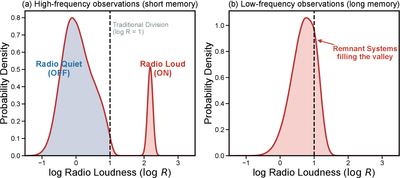
Caption: Figure 4.
Illustrative frequency-dependent radio-loudness distributions from a single intermittent engine population (fduty ≃ 10%). Both panels adopt the illustrative parameters of Section 2.6 (tswitch = 5 Myr, B = 10 μG, z = 0.5) with a lognormal host star formation floor (﹩\langle \mathrm{log}{R}_{{\rm{SF}}}\rangle =-0.3﹩, scatter 0.3 dex). (a) At high frequencies (νobs = 5 GHz, χν ≈ 2.4, short memory), the Beta shape parameter α = λ↑τν < 1, so the stationary distribution of the normalized extended-radio response piles up near Y ≈ 0; combined with the host star formation floor, this produces a bimodal ﹩p(\mathrm{log}R)﹩ with a pronounced valley near the classical ﹩\mathrm{log}R=1﹩ boundary. (b) At low frequencies (νobs = 150 MHz, χν ≈ 14, long memory) α > 1 and the Beta distribution becomes unimodal; fading and remnant systems fill the valley, yielding a broad, continuous distribution. The variance of the normalized extended-radio response shrinks as ﹩{(1+{\chi }_{\nu })}^{-1}﹩ (Equation (18)). These distributions are an existence proof, not a fit to data. The adopted parameters are illustrative (Section 2.6). Proper interpretation of observed samples requires subtracting the host contribution and accounting for surface-brightness selection.
Other Images in This Article
Copyright and Terms & Conditions
© 2026. The Author(s). Published by the American Astronomical Society.

