

Image Details
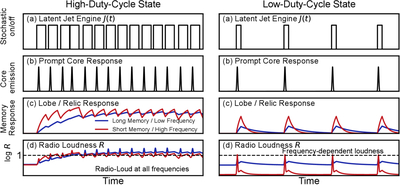
Caption: Figure 2.
Time-domain origin of radio-loudness in the TDRL framework. Panels show: (a) the underlying engine state J(t) modeled as a stochastic on/off process, (b) the prompt compact-core emission modulated by beaming, (c) the lobe emission smoothed by the frequency-dependent fading function for short-memory (high frequency, green) and long-memory (low frequency, red) observations, and (d) the resulting observed scalar radio-loudness R. A single intermittent engine produces either a bimodal or a continuous ﹩p(\mathrm{log}R)﹩ depending on χν = τν/tswitch and on whether the survey recovers diffuse emission.
Other Images in This Article
Copyright and Terms & Conditions
© 2026. The Author(s). Published by the American Astronomical Society.

Copyright ©
2026 Astronomy Image Explorer. All Rights Reserved.
