

Image Details
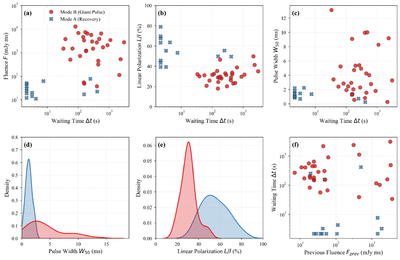
Caption: Figure 3.
Bimodal classification of single pulses from J2237+2828 reveals an asymmetric energy accumulation and release cycle. The scatter plots classify pulses into Mode A (recovery, blue) and Mode B (giant pulse, red) based on K-means clustering. (a) Strong positive correlation between waiting time (Δt) and the fluence of the subsequent pulse (F), indicating a magnetospheric charging process. (b) Negative correlation between Δt and linear polarization fraction (L/I). Long wait pulses (Mode B) are less polarized. (c) Positive correlation between Δt and pulse width (W50). Energetic Mode B pulses are significantly wider. (d), (e) Kernel density estimation distributions for pulse width and linear polarization, highlighting the distinct physical properties of the two modes. (f) Relationship between the previous pulse fluence and waiting time. The data suggest a dynamic cycle where long accumulation leads to high-energy, broad, depolarized bursts (Mode B), followed by rapid, weak, highly polarized recovery bursts (Mode A).
Other Images in This Article
Copyright and Terms & Conditions
© 2026. The Author(s). Published by the American Astronomical Society.

