

Image Details
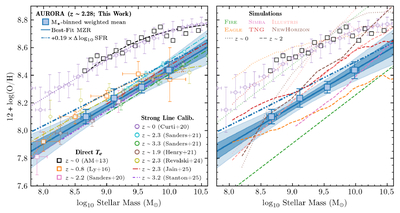
Caption: Figure 4.
Left: our best-fit mass–metallicity relation compared to past direct Te (C. Ly et al. 2016; M. Curti et al. 2020; R. L. Sanders et al. 2020) and strong-line calibration (A. Henry et al. 2021; R. L. Sanders et al. 2021; M. Revalski et al. 2024; S. Jain et al. 2026; T. M. Stanton et al. 2026) MZR measurements. We find our MZR is in strong agreement with past MZR studies. We also include our ﹩0.19\times {\rm{\Delta }}{\mathrm{log}}_{10}{\rm{SFR}}﹩ corrected MZR that takes into account the bias toward high-SFR, low-mass systems. This MZR is found to result in increased ﹩12+\mathrm{log}({\rm{O}}/{\rm{H}})﹩ toward low mass relative to past MZR studies. However, the level of correction needed is uncertain. Right: comparison of our MZR to different simulation predictions compiled by A. M. Garcia et al. (2025), including FIRE (X. Ma et al. 2016) and NewHorizon (Y. Dubois et al. 2021). Only Illustris and NewHorizon match in terms of normalization but have a steeper slope. All other simulations are found to have widely different normalizations but slopes consistent with our MZR measurement.
Other Images in This Article
Copyright and Terms & Conditions
© 2026. The Author(s). Published by the American Astronomical Society.

