Image Details

Choose export citation format:

Weywot, an Unusually Low-albedo Satellite in the Trans-Neptunian Region

  • Authors: Estela Fernández-Valenzuela, Bryan J. Holler, Jose Luis Ortiz, Flavia Luane Rommel, Benjamin Proudfoot, Cameron Collyer, Mónica Vara-Lubiano, Nicolas Morales, Rodrigo Leiva, Marc W. Buie, Stephen E. Levine, Michael Collins, Vadim Nikitin, Michael F. Skrutskie, Anne J. Verbiscer, Wayne Rosing, Bruno Morgado, Altair Ramos Gomes Júnior, Mike Kretlow, Josselin Desmars, Chrystian Luciano Pereira, Xavier Inosencio, Pablo Santos-Sanz, Yücel Kiliç, John Stansberry, Rosemary Pike, Amanda A. Sickafoose, Carlos A. Zuluaga, Amanda S. Bosh, Michael J. Person, Karsten Schindler, Robert Jones, Riley DeColibus, Joel H. Castro-Chacón, Nancy Chanover, Russet McMillan, Richard Boyle, Aaron Golden, Michael Ryan, Ryder Strauss, Hannah Zigo, Simon Porter, Malia Kao

Estela Fernández-Valenzuela et al 2026 The Astrophysical Journal Letters 1002 .

  • Provider: AAS Journals

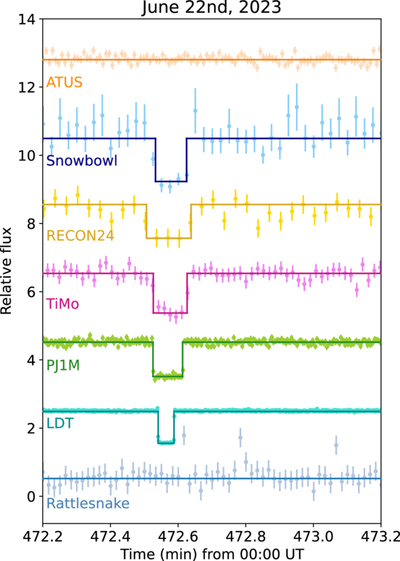
Caption: Figure 3.

Positive and closest negative occultation light curves on the 2023 June 22 event, ordered from the northernmost to the southernmost observing site. Data points represent the observational measurements, while the overlaid lines correspond to the best-fit square-well models. For the LDT dataset, the overlaid curve is shown using the timing from the convolved model, but does not represent the convolved model itself; the square-well profile is displayed for visualization purposes only. Flux offsets were added for visualization purposes.

Other Images in This Article
Copyright and Terms & Conditions

Additional terms of reuse