Image Details

Choose export citation format:

Weywot, an Unusually Low-albedo Satellite in the Trans-Neptunian Region

  • Authors: Estela Fernández-Valenzuela, Bryan J. Holler, Jose Luis Ortiz, Flavia Luane Rommel, Benjamin Proudfoot, Cameron Collyer, Mónica Vara-Lubiano, Nicolas Morales, Rodrigo Leiva, Marc W. Buie, Stephen E. Levine, Michael Collins, Vadim Nikitin, Michael F. Skrutskie, Anne J. Verbiscer, Wayne Rosing, Bruno Morgado, Altair Ramos Gomes Júnior, Mike Kretlow, Josselin Desmars, Chrystian Luciano Pereira, Xavier Inosencio, Pablo Santos-Sanz, Yücel Kiliç, John Stansberry, Rosemary Pike, Amanda A. Sickafoose, Carlos A. Zuluaga, Amanda S. Bosh, Michael J. Person, Karsten Schindler, Robert Jones, Riley DeColibus, Joel H. Castro-Chacón, Nancy Chanover, Russet McMillan, Richard Boyle, Aaron Golden, Michael Ryan, Ryder Strauss, Hannah Zigo, Simon Porter, Malia Kao

Estela Fernández-Valenzuela et al 2026 The Astrophysical Journal Letters 1002 .

  • Provider: AAS Journals

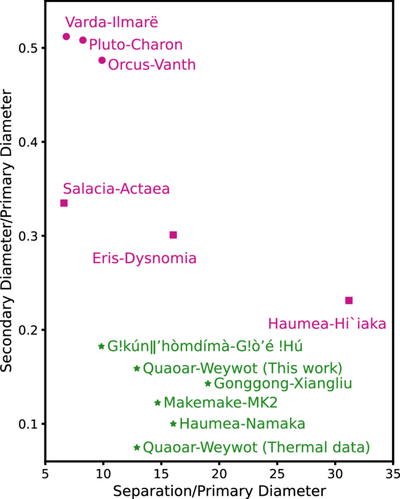
Caption: Figure 1.

Relation between the relative size of the system components and their separation for TNOs with primary components over 700 km. There appear to be two distinct subclasses among the most massive TNO binary systems: those with larger satellites and close separation (pink markers) and those with smaller satellites and larger separations (green stars). Relative diameters and satellite orbital parameters are taken from the Johnston Archive (www.johnstonsarchive.net/astro/astmoontable.html) and references therein.

Other Images in This Article
Copyright and Terms & Conditions

Additional terms of reuse