

Image Details
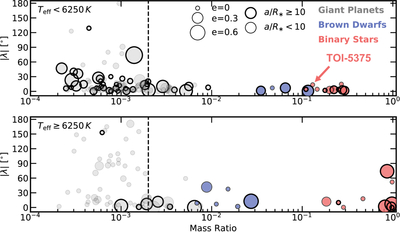
Caption: Figure 4.
Projected stellar obliquity (λ) of three companion classes as a function of the companion-to-primary mass ratio. The top and bottom panels shows the systems with cool and hot primary stars, defined according to the Kraft break. The size of the symbol is proportional to the orbital eccentricity while the dots highlighted by a thick boundary represent companions with large scaled semimajor axis (a/R* ≥ 10). The vertical black dashed line marks the empirical boundary at 2 × 10³ that separates aligned high-mass-ratio systems and misaligned low-mass-ratio systems, proposed by J. Rusznak et al. (2025) based on a mixed giant planet and brown dwarf sample. The low-mass-ratio systems exhibit more dispersed obliquities regardless of stellar temperature. Wide-orbit companions, regardless of their masses, are likely aligned. No significant correlation between eccentricity and obliquity is seen in the sample.
Other Images in This Article
Copyright and Terms & Conditions
© 2026. The Author(s). Published by the American Astronomical Society.

