

Image Details
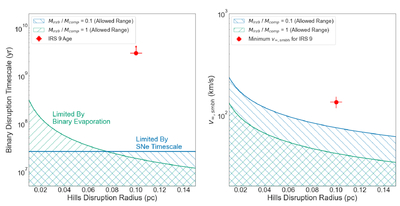
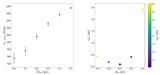
Caption: Figure 5.
Binary disruption timescale (left) and v∞,smbh (right) as a function of Hills disruption radius for hypothetical binary systems containing IRS 9. The allowed ranges for an Mirs9/Mcomp = 1 system (green hashed region) and an Mirs9/Mcomp = 0.1 system (blue hashed region) are shown, as well as the current values for IRS 9 (red points). Assuming that the Hills disruption occurred at the minimum periapse of IRS 9’s current orbit (rperi = 0.1 pc), the disruption timescales of the binary systems are ≲30 Myr. Given IRS 9’s current age of ≳3 Gyr, the binary systems could not survive long enough to disrupt within the past 0.4 Myr. Further, the binary systems cannot achieve the minimum v∞,smbh of IRS 9 (134 ± 18 km s−1, calculated assuming ∣dlos∣ = 0 pc) via the Hills mechanism at a disruption radius of 0.1 pc.
Other Images in This Article
Copyright and Terms & Conditions
© 2026. The Author(s). Published by the American Astronomical Society.

