

Image Details
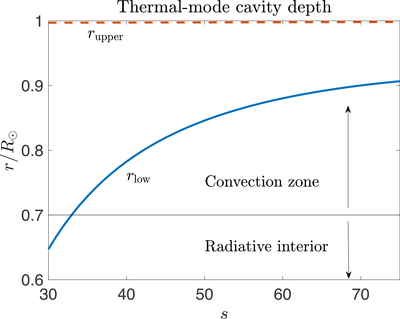
Caption: Figure 3.
Rough estimates of the upper rupper (dashed red line) and lower rlow (solid blue line) turning points of the thermal mode R2 shown in Figure 2. We use the frequencies and wavenumbers of the modes as measured along the ridge as inputs to the scaling relations rlow/R⊙ ≈ 1–3Ω⊙/(sσ) and rupper/R⊙ ≈ 1–5σ/(16sΩ⊙) (B. W. Hindman & R. Jain 2022). Although these theoretical relations describe a cavity that straddles the entire solar convection zone, thermal modes are not observed in the shallow surface layers r/R⊙ ≳ 0.98. Thus, we cannot comment on the depth penetration of these waves and the thermal-mode cavity size unless we directly observe them propagating at those layers. If the modes were to indeed propagate as deeply as suggested in this figure, it would suggest that the bulk is effectively nonconvecting.
Other Images in This Article
Copyright and Terms & Conditions
© 2026. The Author(s). Published by the American Astronomical Society.

