

Image Details
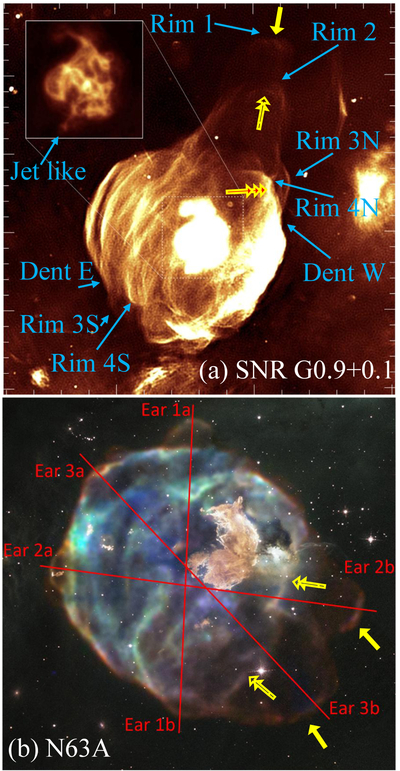
Caption: Figure 4.
Two images of CCSNRs where at least one shell is partial. (a) A MeerKat radio image at 1.28 GHz of SNR G0.9+0.1 adapted from I. Heywood et al. (2022). The inset on the upper left is a desaturated image of the pulsar wind nebula. N. Soker (2025a) added the pale-blue marks of structural features used to identify the point-symmetric morphology. For a line of sight along the large ear in the north, the three shells (their projection on the plane of the sky forms the rims) might form three photospheric shells. The first two (pointed at by the solid one-head yellow arrow and double-lined double-headed yellow arrow) are partial. The third shell (pointed at by the three-headed arrow) is the main shell of the supernova remnant. (b) A Chandra X-ray image of N63A (red, green, and blue for different X-ray energy bands); see also E. Karagöz et al. (2023). N. Soker (2024d) added the three red lines between the tips of opposite ears to mark the symmetry axis of three pairs of jets that participated in the explosion of this point-symmetric CCSNR. Each ear’s front can form the first photospheric shell, depending on the viewing angle. The main CCSNR forms the next photospheric radius. The light brown region to the upper right of the three red lines is optical light detected by Hubble. (Credit: enhanced Image by Judy Schmidt based on images provided courtesy of NASA/Chandra X-ray Observatory/Smithsonian Astrophysical Observatory and NASA/STScI.)
Other Images in This Article
Copyright and Terms & Conditions
© 2025. The Author(s). Published by the American Astronomical Society.

