

Image Details
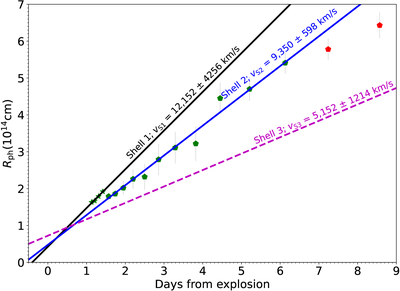
Caption: Figure 1.
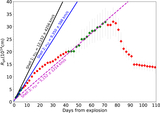
The time evolution of the photospheric radius from E. A. Zimmerman et al. (2024) based on photometry (not on spectroscopy). We fit two straight lines through two groups of points: the first four points, green stars, at t = 1.13–1.42 days that we mark as Shell 1, and the next 11 points, green pentagons, at t = 1.57–6.13 days that we mark as Shell 2. The red pentagons are excluded from the fitting; they belong to the phase when the photosphere is moving inward in the mass coordinate of the ejecta. We also indicate the velocity of each shell during the fitting period. The line for Shell 3 fits a later time period, as shown in Figure 2. We identify these shells as photospheric shells appearing one after the other. The straight lines for the three shells are Rph1 = 1.050t + 0.425, Rph2 = 0.808t + 0.477, and Rph3 = 0.445t + 0.723, where the time is in days and the radius in units of 1014 cm. All lines have a coefficient of determination (R-Squared) of R2 = 0.98. The velocities and their uncertainties are from fitting the ejecta photosphere radii without including the radii of the shells at t = 0. Including the radii at t = 0 changes the velocities little but substantially reduces the uncertainties, indicating that the three shells are distinct, by these photospheric radii (caveat: see the text on the possibility that Shells 1 and 2 are a single shell).
Other Images in This Article
Copyright and Terms & Conditions
© 2025. The Author(s). Published by the American Astronomical Society.

