

Image Details
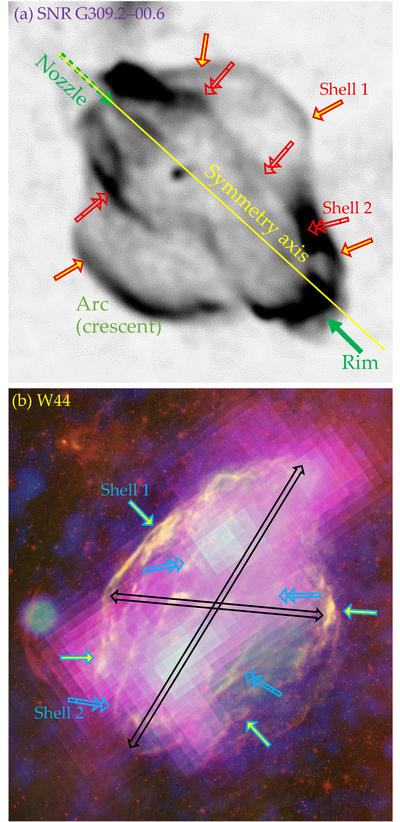
Caption: Figure 3.
Two images of CCSN remnants with two full (or almost full) shells (but not spherical). Studies attributed their morphologies to the JJEM. In each image, we marked the two prominent shells that can form two photospheric shells one after the other during the photospheric phase of such CCSNe; the arrows point to only four points on the projection of each shell boundary onto the plane of the sky. Filled double-lined arrows point at the first shell, and the empty double-lined double-headed arrows point at the second shell. (a) A radio image of SNR G309.2-00.6 adapted from B. M. Gaensler et al. (1998), who already argued that jets shaped this CCSN. The rim-nozzle symmetry marks are from N. Soker (2024b). (b) A composite image of CCSNR W44 from a NASA site (www.nasa.gov/universe/nasas-fermi-proves-supernova-remnants-produce-cosmic-rays/). N. Soker (2024c) added the two double-headed arrows that depict the two axes of the two energetic pairs of jets that participated in the explosion of W44. Magenta: GeV gamma-ray from Fermi’s Large Area Telescope (LAT); yellow: radio from the Karl G. Jansky Very Large Array; red: infrared; blue: X-ray from ROSAT. Credit: NASA/Department of Energy/Fermi LAT Collaboration, NRAO/Associated Universities Inc., JPL-Caltech, and ROSAT.
Other Images in This Article
Copyright and Terms & Conditions
© 2025. The Author(s). Published by the American Astronomical Society.

