

Image Details
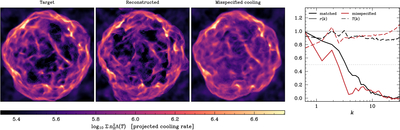
Caption: Figure 15.
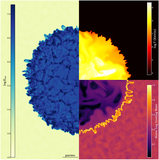
Reconstruction of a radiatively cooling SNR from a single projected emission proxy. The first three panels show the target projected cooling rate, ﹩I(x,y)={\sum }_{z}{n}_{{\rm{H}}}^{2}{\rm{\Lambda }}(T)﹩, the best-fit reconstruction using the matched fiducial cooling model, and a reconstruction using a deliberately misspecified Grackle-derived cooling curve. Right: cross-correlation coefficient r(k) (solid) and transfer function T(k) (dashed) of the reconstructed 3D final density field relative to the ground truth, for the matched (black) and misspecified (red) cooling models. For the matched model, r(k) ≃ 0.99 on the box scale and declines toward smaller scales, while T(k) remains close to unity across the driving band. Cooling-model misspecification primarily reduces intermediate-scale phase fidelity. Gaussian noise with a standard deviation equal to the rms fluctuations of the simulated observable is added to the target. Although the final-state large-scale structure is recovered, the underlying initial turbulent phases are not uniquely constrained (see Section 8.2).
Other Images in This Article
Show More
Copyright and Terms & Conditions
© 2026. The Author(s). Published by the American Astronomical Society.

