

Image Details
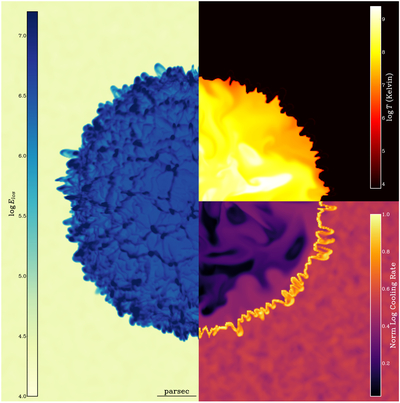
Caption: Figure 6.
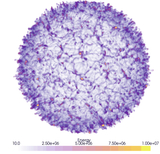
SNR in a turbulent, radiatively cooling medium. A 1051 erg explosion evolves into a multiphase remnant at ∼1 kyr whose morphology is shaped by ambient density fluctuations and cooling. The left projection panel (total energy) shows the forward solution at the same time as the diagnostic slices on the right (top: temperature, bottom: cooling rate). The shock has expanded to an approximately Sedov–Taylor radius but is visibly corrugated by interactions with overdense clumps and underdense channels. A thin, dense swept-up shell forms behind the shock; its angular variations trace the pre-existing turbulence and cooling efficiency. The hot interior is strongly vortical and mottled from repeated shock–cloud interactions, while Rayleigh–Taylor fingers protrude from the decelerating shell and are further shredded by Kelvin–Helmholtz billows along their flanks and the inner rim where tangential shear is strongest. Together, the panels highlight the coexistence of a globally self-similar expansion with rich small-scale structure produced by turbulence, strong shocks, and radiative losses.
Other Images in This Article
Show More
Copyright and Terms & Conditions
© 2026. The Author(s). Published by the American Astronomical Society.

