

Image Details
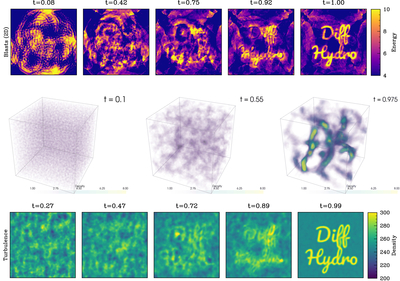
Caption: Figure 12.
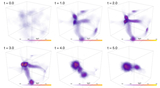
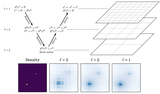
Inverse initial-condition reconstructions in shock-dominated and turbulent test problems. Top row (blasts, 2D): time sequence of midplane internal energy (energy density) in a uniform medium whose initial internal-energy field e(x, 0) has been optimized to match a prescribed late-time target in a 10242 field. The optimized field produces an ensemble of Sedov–Taylor–like explosions: early evolution shows many nearly circular blast waves, which subsequently collide and merge into a curved network of shocks, contact layers, and rarefactions that reorganizes into the target large-scale pattern by t ≃ 1. Middle and bottom rows (turbulence): volume and projected density for a 2563 box initialized with an optimized turbulent velocity realization (Fourier phases treated as control variables) and evolved with pure hydrodynamics. Low-k compressions seeded by the optimized phases sharpen through the turbulent cascade into filaments and knots, assembling into the target projected morphology at the final time. Snapshots are shown at selected intermediate times (code units) chosen to highlight key stages of the reconstruction. Color bars indicate energy (top) and projected density (bottom). Animations are available at doi:10.5281/zenodo.22731680 and https://github.com/bhorowitz/DiffHydro_public/.
Other Images in This Article
Show More
Copyright and Terms & Conditions
© 2026. The Author(s). Published by the American Astronomical Society.

