

Image Details
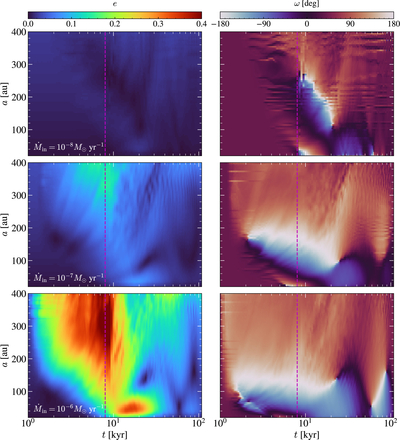
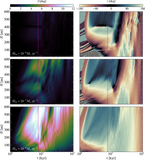
Caption: Figure 3.
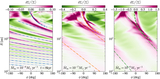
Temporal evolution of the disk eccentricity e (left) and the argument of periapsis ω (right), each averaged azimuthally at fixed semimajor axis a, for mass infall rates of ﹩{\dot{M}}_{{\rm{in}}}=1{0}^{-8}\,{M}_{\odot }\,{{\rm{yr}}}^{-1}﹩ (top), 10−7 M⊙ yr−1 (middle), and 10−6 M⊙ yr−1 (bottom). The period during which infall is halted is indicated by the vertical dashed lines. In all cases, the streamer excites the eccentricity in the outer disk, which then propagates inward. After infall ceases, the eccentricity damps but remains elevated in the inner disk, while the radial gradient of ω drives the “twisting" of the disk.
Other Images in This Article
Show More
Copyright and Terms & Conditions
© 2026. The Author(s). Published by the American Astronomical Society.

