

Image Details
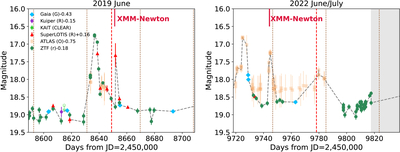
Caption: Figure 2.
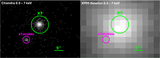
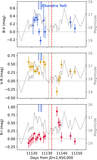
AT 2016blu was observed by XMM-Newton four times, three of which occurred after its first outburst in 2012. The 2019 XMM-Newton observation occurs just before the documented optical peak (this peak is based on a single SuperLOTIS data point with a large uncertainty and should therefore be interpreted with caution), while the two XMM-Newton observations in 2022 correspond to AT 2016blu rising toward its optical peak, as documented by M. Aghakhanloo et al. (2023b, 2025). However, as shown in Figure 1, owing to the low spatial resolution of XMM-Newton, we cannot spatially resolve AT 2016blu from the nearby ULX NGC 4559 X7. Predicted outburst times from the ∼113 and ∼38.5 day periods are shown by the red dashed and brown dotted lines, respectively; gray shaded regions mark periods of limited observability due to the Sun (M. Aghakhanloo et al. 2023b). Following M. Aghakhanloo et al. (2023b, 2025), offsets were applied as constant-flux subtractions; the quoted values correspond to the magnitude shifts at a baseline of 18–18.5 mag. The ZTF exception is the −0.18 mag transformation to Johnson–Bessell R. The same plotting conventions are used throughout the paper.
Other Images in This Article
Copyright and Terms & Conditions
© 2026. The Author(s). Published by the American Astronomical Society.

