

Image Details
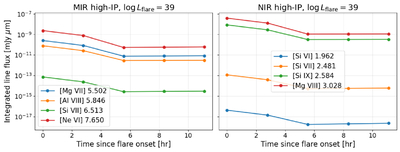
Caption: Figure 4.
Predicted time-dependent line fluxes for representative high-ionization MIR (left) and NIR (right) transitions at ﹩\mathrm{log}{L}_{{\rm{flare}}}=39﹩, computed with CLOUDY. The flare is injected for the first hour of the simulation. Fluxes are shown as equivalent Gaussian peak flux densities assuming an FWHM of 1000 km s−1. The curves are shown in absolute flux-density units to allow direct comparison with observational sensitivity limits and with the requirements for future infrared missions. Some transitions vary by factors of several to more than an order of magnitude in a relative sense; however, their absolute flux densities remain extremely faint (≲10−5 mJy). For comparison, representative JWST sensitivity levels are ∼0.1–1 mJy for MIRI/MRS and ∼10−3–10−2 mJy for favorable NIRSpec/NIRCam observations, depending on wavelength, observing setup, source morphology, and background. For scale, converting representative flux-density sensitivities to integrated line-flux sensitivities for a 5000 km s−1 Gaussian gives ∼1.1 × 10⁻²–1.1 × 10⁻¹ mJy μm near 6 μm for a ∼0.1–1 mJy MIRI/MRS threshold, and ∼4.4 × 10⁻⁵–4.4 × 10⁻⁴ mJy μm near 2.5 μm for a favorable ∼10−3–10−2 mJy NIR threshold. The predicted MIR lines remain many orders of magnitude below these values, while even the brightest NIR high-ionization lines remain at least several hundred to several thousand times too faint. These results demonstrate that even high-ionization lines formed at small radii do not produce detectable variability on hour timescales. The lack of detectable rapid variability reflects the fact that the recombination and cooling timescales of the gas exceed the ∼hour duration of the flare, preventing the ionization state from responding impulsively to the injected radiation.
Other Images in This Article
Copyright and Terms & Conditions
© 2026. The Author(s). Published by the American Astronomical Society.

