

Image Details
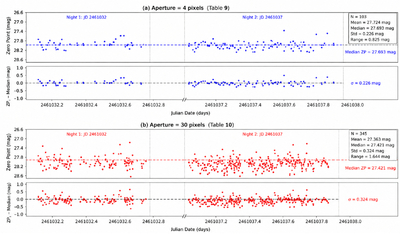
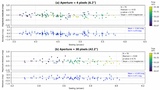
Caption: Figure 4.
Frame-by-frame photometric zero-point stability for the two Astrometrica apertures used in the time-series analysis. Panel (a) shows the results for the 4-pixel aperture (Table 8), while panel (b) shows the results for the 30-pixel aperture (Table 9). In each panel, the upper subpanel displays the measured zero point as a function of Julian date, whereas the lower subpanel shows the residuals relative to the median value of the corresponding dataset, (﹩Z{P}_{i}-\widetilde{ZP}﹩). The dashed horizontal lines indicate the median zero points ((﹩\widetilde{ZP}\,=\,27.693﹩) mag for the 4-pixel aperture and (﹩\widetilde{ZP}\,=\,27.421﹩) mag for the 30-pixel aperture). No significant monotonic drift is observed in either dataset. The larger scatter observed for the 30-pixel aperture is expected because the larger aperture includes a greater contribution from diffuse coma emission and sky background. These results demonstrate that the photometric normalization based on frame-by-frame zero-point corrections effectively removes calibration variations and cannot account for the periodic signals detected in the photometric time series.
Other Images in This Article
Copyright and Terms & Conditions
© 2026. The Author(s). Published by the American Astronomical Society.

