

Image Details
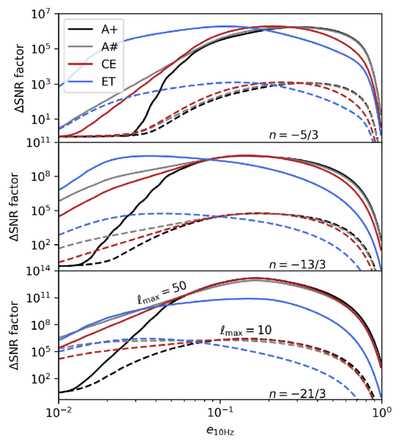
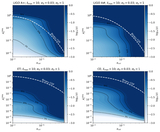
Caption: Figure 4.
Increases in the δSNR as a function of the residual eccentricity at 10 Hz with respect to a circular signal. The results are computed for different detectors (colored lines), dephasing power laws (panels, see Equation (16)) and for two representative choices for ﹩{\ell }_{{\rm{\max }}}﹩ (solid and dashed lines). The curves are computed for a dephasing amplitude of ﹩{A}_{2}^{10{\rm{H}}z}=1{0}^{-15}﹩, ensuring that no eccentric harmonic is ever saturated. Note that the maximum achieved δSNR factors scales roughly as ﹩{\ell }_{{\rm{\max }}}^{1-n}﹩, and that these values are reached for a range of moderate eccentricities. The n values have been chosen to represent the leading scaling of the GW phase (n = −5/3), a typical EE (n = −13/3), and a very steeply decaying EE (n = −21/3) to illustrate the extreme scaling of the dephasing in each harmonic. Indeed, the n = −5/3 results are essentially showing an increased capacity to determine the binary’s chirp mass (recall the F−5/3 scaling of the vacuum GW phase), a phenomenon already studied in B. Moore & N. Yunes (2020).
Other Images in This Article
Copyright and Terms & Conditions
© 2026. The Author(s). Published by the American Astronomical Society.

