

Image Details
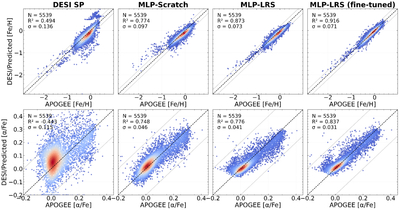
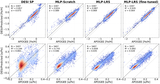
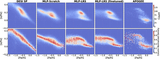
Caption: Figure 2.
Comparison of [Fe/H] and [α/Fe] estimates between the DESI SP pipeline and MLP-based models, referenced against APOGEE DR17 labels. From left to right: DESI SP: DESI SP pipeline, MLP-Scratch: MLP trained from scratch on the same number of DESI spectra used for fine-tuning, MLP-LRS: MLP pretrained on LAMOST LRS (zero-shot application), and MLP-LRS (fine-tuned): MLP pretrained on LAMOST LRS and fine-tuned with DESI spectra. The first row shows [Fe/H] results; the second row shows [α/Fe]. Legends list the number of test stars (N), coefficient of determination (R2), and the robustly estimated standard deviation of the residuals (σ, computed after 3σ clipping with sigma_clip in astropy). All sources are restricted to Teff > 4000 K. The dashed black line indicates the ideal one-to-one relation, and the gray dotted lines mark 0.2 dex deviations. The fine-tuning set consists of 2069 stars. A comparison using the clean, calibrated DESI SP subset is provided in Appendix D.
Other Images in This Article
Show More
Copyright and Terms & Conditions
© 2026. The Author(s). Published by the American Astronomical Society.

