

Image Details
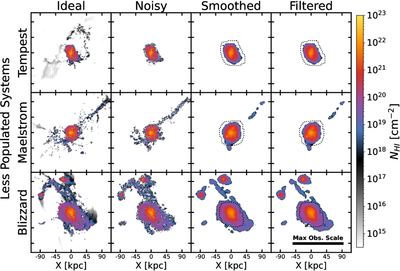
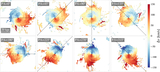
Caption: Figure 2.
Effects of various steps of the synthetic H I imaging pipeline for the three less-populated galaxies at 20 Mpc at an inclination of 40°. Plots show the MHONGOOSE-LR survey parameters. See the Appendix for the other survey realizations. The scale bar on the bottom right shows the maximum observable angle at this minimum baseline. The first column (Ideal) shows the ideal column density projections (vertical striping arises from projecting lower resolution grid cells along nongrid axes, see Section 7.3). The second column (Noisy) adds Gaussian noise with a standard deviation equal to 0.2 times the sensitivity limit. For this column and the final two, only sources identified as significant are plotted. The third column (Smoothed) shows the effects of the primary beam and the Gaussian smoothing kernel, which limit the field of view and remove signals with small spatial scales, respectively. The final column (Filtered) shows the effect of spatially filtering the data. The three galaxies presented respond to this step in distinct ways, related to how much diffuse gas is present around the disk. This has little effect on Tempest and Maelstrom, but has a larger effect on Blizzard due to the presence of a more diffuse signal. The dashed lines in the right two panels show the dilated mask used to separate the disk and the CGM H I .
Other Images in This Article
Show More
Copyright and Terms & Conditions
© 2026. The Author(s). Published by the American Astronomical Society.

