

Image Details
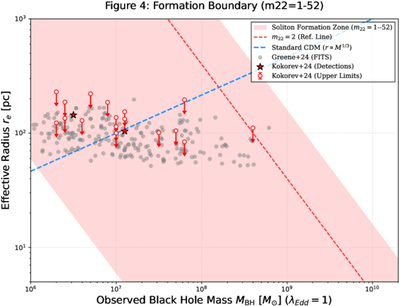
Caption: Figure 4.
The size–mass plane of Little Red Dots (LRDs), comparing observed effective radii re with illustrative FDM soliton compactness limits. The red shaded region indicates the “soliton formation zone,” defined by the minimum radii implied by the soliton scaling for different boson masses. The horizontal axis represents the observed black hole mass (MBH), which does not necessarily equal the underlying soliton mass (Mc) during the early progenitor phase. The dashed red line shows our fiducial baseline (m22 = 2) under the direct-mapping assumption (MBH ≈ Mc). LRD measurements from J. E. Greene et al. (2024) and V. Kokorev et al. (2024) are overplotted. In the progenitor phase interpretation (MBH < Mc), the horizontal scatter of the observational data reflects the growth track of black holes at a fixed m22 within larger, fixed soliton cores (Mc ≫ MBH), rather than a varying m22. This resolves the apparent tension with the m22 ≈ 2 estimate in Section 2.1, which strictly assumes a mature, direct-mapping (MBH ≈ Mc) scenario. This interpretation allows the observed LRDs to be consistent with heavier boson masses (m22 ≳ 20, consistent with Lyα constraints) while still utilizing the deep soliton potential to trigger the initial collapse.
Other Images in This Article
Copyright and Terms & Conditions
© 2026. The Author(s). Published by the American Astronomical Society.

